
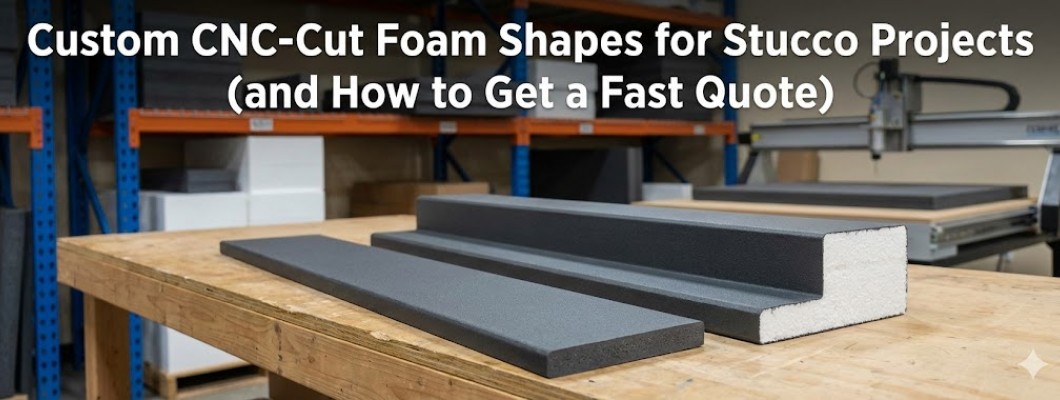
Custom CNC‑Cut Foam Shapes for Stucco Projects (and How to Get a Fast Quote)
When you need more than standard trim, custom CNC‑cut foam shapes can turn a plain stucco project into something that really stands out.
This guide is for homeowners and contractors in Sacramento, the greater Northern California region, and similar stucco-heavy areas like Southern California, Florida, Washington State, Oregon, Texas, and Las Vegas who want to:
- Use custom foam details (cornices, corbels, columns, arches, quoins, keystones, flat stock, and more)
- Understand what’s possible with CNC‑cut foam
- Get a clear, accurate quote from Invicta Foam Products without back‑and‑forth delays
Pre‑Designed vs. Custom Foam Shapes
Invicta Foam Products offers both:
- Pre‑designed shapes for easy ordering
- Common profiles (trim, sills, flat stock, basic cornices, etc.) are ready to go in standard sizes, typically manufactured in 8‑foot lengths.
- Fully custom CNC‑cut shapes
When your project calls for a special profile, matching an existing detail, or a unique design, our CNC process can cut:
- Crown moldings and cornices
- Corbels and brackets
- Columns, bases, and capitals
- Arches and curved surrounds
- Quoins, keystones, window sills, and trim
- Flat stock in custom dimensions
- Decorative panels, dentils, and other accents
Custom foam details are especially useful on:
- High‑end homes in Sacramento, Granite Bay, Folsom, and nearby cities
- Multi‑unit projects and community entrances in Southern California, Las Vegas, and Texas
- Coastal and weather‑exposed projects in Florida, Washington State, and Oregon where lightweight, coated foam performs well when installed to industry standards
How CNC‑Cut Foam Shapes Are Made (In Plain Language)
Here’s what happens behind the scenes when you order custom foam shapes:
- Your profile is designed
- A molding or shape profile is created digitally. Our CNC machine follows this profile exactly.
- The foam is precision‑cut
- The machine cuts the desired contour into the foam, producing highly uniform pieces, usually in 8‑foot lengths (longer or shorter lengths are available when needed).
- Mesh and base coat are applied
- After shaping and pre‑cutting, a fiberglass mesh is adhered over the exposed areas. A thin brown‑coat is spread evenly over the surface, providing a protective, durable bond‑coat that’s ready for final texturing or painting once installed.
- Joints are reinforced on site
- Seams and joints between adjacent pre‑basecoated pieces (such as crown molding in soffits) are typically spliced with additional fiberglass mesh tape before the final finish coat.
- Lightweight installation
- Because the foam is light, most pieces can be installed by one or two craftsmen using a compatible bonding agent, along with mechanical support where spans extend far from the wall.
The result: consistent shapes, easier handling, and a clean finished appearance that works well on both new and existing stucco projects.
When Custom CNC Shapes Make Sense
You may want to consider custom foam shapes when:
- You’re matching existing details
- Historic homes, custom builds, or previous phases of a project may have unique profiles that standard catalogs don’t cover.
- The design calls for special curves or radii
- Arched windows and doors, radius walls, and curved parapets often need custom‑cut profiles so everything lines up cleanly.
- You want bolder architectural features
- Dentils, deep cornices, decorative brackets, and column details can give more presence to entries, balconies, and rooflines.
- You’re working with strict weight or installation limits
- Lightweight foam is easier to handle and can often simplify installation compared to heavier materials.
Whether you’re finishing a custom home in Sacramento or refreshing a resort property in Las Vegas or coastal Florida, CNC‑cut foam can help you get the look you want without overcomplicating installation.
What to Prepare Before You Request a Custom‑Shape Quote
A little preparation will make your quote faster and more accurate. Before you reach out, gather:
1. Basic Project Info
- Is this a single home, multi‑unit building, or commercial project?
- Is it new construction, a remodel, or a refresh of existing stucco?
- Project location (city and state) — helpful for planning logistics and understanding local conditions in places like Sacramento, Southern California, Florida, Washington State, Oregon, Texas, or Las Vegas.
2. Shape Type and Location
Tell us where the foam shapes will be used and what kind of details you’re looking for, for example:
- Crown molding and cornices along rooflines, parapets, or soffits
- Corbels and brackets under balconies, eaves, or canopies
- Columns, bases, and capitals at entries or porch areas
- Quoins at outside building corners
- Arches and curves around windows, doors, or special openings
- Keystones, window sills, and trim to frame openings
- Flat stock for bands, reveals, and other linear details
Photos marked up with arrows or short notes work very well.
3. Dimensions and Profiles
For each shape or area, provide as much of the following as you can:
- Approximate height, width, and projection of the profile
- Length of each run (or number of pieces), especially for long bands or cornices
- Whether you need standard 8‑foot lengths or specific lengths cut to size
- Any existing profile you want to match (a sketch, photo, or CAD file is ideal)
Tip: For custom shapes, making sure the dimensions are correct (including the difference between radius and diameter) avoids delays and wasted material.
4. Drawings, Sketches, or CAD Files (Optional but Helpful)
If you or your designer have access to CAD software (AutoCAD, BobCAD, or any program that can export DXF files), you can:
- Draw the shape as a simple 2‑D closed spline to the scale you want it cut
- Ensure all parts of the shape are at least ½ inch thick so the foam performs well
- Note whether the piece will be a thin wall decoration or a full‑length rail or band
Sending these files with your quote request can reduce design time and cost for custom work.
Popular Custom Options We Help With
Here are a few of the most common custom foam solutions we see in California and nationwide:
- Custom flat stock and bands
- Standard and non‑standard widths and thicknesses, including options with rounded or bullnosed edges.
- Decorative cornices and crown moldings
- From clean, modern lines to more traditional, stepped profiles for high‑visibility rooflines.
- Corbels, brackets, and dentils
- Shorter cut sections or repeated blocks to add rhythm and depth under eaves, balconies, or entries.
- Columns, bases, and capitals
- Round, straight‑sided, fluted, or shaped columns with coordinated bases and capitals.
- Quoins and corner details
- L‑shaped pieces that alternate up the corner, sized to your thickness, height, and width requirements.
- Arches, curves, and keystones
- Profiles bent to match specific inner/outer radii for arched windows, doors, or decorative insets.
- Decorative panels, text, and logos
- Foam can be cut as raised shapes or recesses, making it useful for signage, wall medallions, or feature panels.
If you don’t see your exact idea listed here, share a sketch or photo — custom CNC foam is extremely flexible.
What to Expect When You Request a Custom Shape Quote
When you contact Invicta Foam Products for a custom foam quote, here’s the basic process:
- Share your project and design details
- Send us your project location, photos, measurements, and any sketches or CAD files you have.
- We review and refine your shapes
- Our team reviews your information, checks that the shapes work within foam limitations, and confirms details like thickness, lengths, and any needed support or drip slopes for exterior use.
- You receive pricing and options
- We provide a quote for the foam pieces along with any suggested adjustments that could simplify installation or reduce waste.
- Production and delivery coordination
- Once approved, your shapes are programmed, cut, coated, and prepared for delivery or pickup according to the schedule we discuss with you.
Throughout the process, the goal is to keep things clear, predictable, and contractor‑friendly so you can focus on the rest of your project.